April 25, 2006
Taking a break
On May 6, this blog will have been appearing almost daily for a couple of years.
The text alone for the entries runs to 2.5 M of ASCII. Each day I clean the junk comments and trackbacks away, leave some more content on a disk at our ISP, spend time writing stuff down that'll be forgotten soon, perhaps post a picture relatives and friends can look at once or twice.
Many of you have added your comments to entries. Thanks for those, and thanks for reading along.
It's time to take a break.
Posted by Mark at 09:26 PM | Comments (4) | TrackBack
April 24, 2006
Rough circles
This morning as I rolled into work on the bike, the weather was great. As I knew a huge pile of things to do awaits me here, I decided to enjoy the ride.
Saturday I replaced the SPD pedals on the mountain bike. The new pedals grip the cleats better. I tried an exercise suggested in one of the articles Andy found. The exercise consists of putting the bike in an easy gear and using only one leg to pedal. Very strange. I'm definitely not making perfectly smooth circles yet. There's sort of a whoosh on the downstroke and nothing on parts of the upstroke.
Posted by Mark at 09:03 AM | TrackBack
April 20, 2006
High Mach
Digg had a link to this test of how Machiavellian you are. My score was 63/100.
You are a high Mach, you endorse Machiavelli's opinions.
That didn't surprise me much. To get a low score, you'd need to be twistedly Machiavellian enough not to admit to yourself that you're manipulative.
Posted by Mark at 02:15 PM | TrackBack
Nightmares
Yet another early morning of eerie nightmares. For the last few days the nightmares have involved ghoulish surgical violence, moods of capitulation, despair that persists on awaking.
I went to bed almost an hour earlier than usual. Managed to read about a page before feeling too tired to focus, but then could not fall asleep normally, and instead tossed and turned.
It took almost half an hour to get out of bed. I wondered about people who say they like to lie in their beds in the morning, going back to sleep after they wake up. Nath says she likes to stay in bed. People who do must not be lying there feeling crushed by depression or illness. Instead they actually feel better than when they get up and get going. Amazing.
Posted by Mark at 06:32 AM | Comments (1) | TrackBack
April 11, 2006
~45:00/~145
As my right shin is bothering me, I planned to ride, but ended up not even riding at noon. Instead I measured myself riding home, and doubled that to get about 45 minutes at a heart rate of about 145 for the 4 short bike legs of the trip.
My muscles are exhausted. I notice that more on the bike than on foot. On foot the soreness and stiffness is obvious, but the lack of muscle power is not. On the bike the lack of muscle power is clear. So Matt was no doubt right. The best training I can do right now is to recover.
Posted by Mark at 09:04 PM | TrackBack
March 31, 2006
Atheists America's most distrusted
A study by some folks at the University of Minnesota identified atheists as America's most distrusted minority.
I've gotten mail on the subject and seen the article mentioned in various places around the blogosphere. This may be one of those studies that gets more attention outside than inside the United States.
What was the context?
From a telephone sampling of more than 2,000 households, university researchers found that Americans rate atheists below Muslims, recent immigrants, gays and lesbians and other minority groups in "sharing their vision of American society." Atheists are also the minority group most Americans are least willing to allow their children to marry.
That got me thinking about how the methodology. Did they have some students make these calls?
Hello?Mr. Craig?
Yes.
Hi, this is Jane Smith from the University of Minnesota. We're conducting a telephone survey of Americans like yourself, looking at which minorities you consider least trustworthy...
Phone marketing people. No, make that people who manage phone marketing people.
...Huh? Let me ask you a few questions and get your rankings for these minority groups.
Well, we were just sitting down to dinner...
That's okay. This will only take a few minutes. Question 1. In order of most to least, how do the following groups rate at sharing your vision of American society?
According to one of the researchers, apparently only 3% of people in the US are atheists.
Posted by Mark at 04:20 PM | TrackBack
March 29, 2006
Stuck, part II
As I only had one book going home on the train, Lila: An Inquiry Into Morals, I came unstuck by pressing on. In essence I gave up on the theoretical underpinnings of the Metaphysics of Quality. Chapter 8 went by in a haze.
The next chapter was going okay this evening until Tim came up for the third time to tell me he couldn't go to sleep until I printed a copy of the periodic table of the elements for his personal use. Emma didn't want to go to bed until I'd quizzed her on a few simple additions.
Nath took Diane this afternoon to the chiropractor, who gently realigned Diane's spine and relieved tension in Diane's neck. The chiropractor asked Diane if she was a little girl or a big girl. Diane said she was a little girl. The chiropractor suggested maybe the problem started when Diane got to sleep in her mom's bed during the ski holiday, and managed to monopolize Mom all day, each day that week.
When they returned home from vacation, Diane had to sleep in her own bed and time share with her brother and sister. She had to go back to school. The only time she could get Mom's undivided attention just for her was in the middle of the night.
So the chiropractor recommended what we already knew, which is to ignore Diane in the middle of the night, and to pay some attention to her, by herself, during the day. Easier said than done, of course. The alternatives are probably worse, though.
Posted by Mark at 09:08 PM | Comments (2) | TrackBack
Stuck
The stack of books in progress is growing deeper. I'm now interrupting Kafka's short stories, which interrupted Schlesinger's work on Andrew Jackson's presidency, which interrupted a collection of George Steiner's essays, to read Lila: An Inquiry Into Morals by Robert M. Pirsig. I'm stuck at p. 122:
There's a principle in physics that if a thing can't be distinguished from anything else it doesn't exist.
Up to that point I was reading along with minor to major disagreements here and there, suspecting that Pirsig's going to get around logic by sleight of mind. Not that he's going to do it intentionally. He'll be just as amazed by the magic as the rest of us.
Yet here he seemed to be laying out axioms from which he's going to mount his attack on the empiricist position. You sort of want him to win, because you feel, too, that the empiricists have missed the point.
Then you realize that if you take the first sentence of his argument at face value, you have to agree that the universe doesn't exist. Hmm.
Posted by Mark at 12:47 PM | TrackBack
Shortening lifespan
Forbes.com has an article about how CEOs really ought to manage their stress.
"We've thought for a long time that type A personalities were predisposed to cardiovascular problems, but it turns out it's those who have increased rage and negative stress who have a higher risk for heart disease," says Dr. Woodson Merrell, M. Anthony Fischer director of Integrative Medicine at the Continuum Center for Health and Healing at Beth Israel hospital in New York City.
From here on in, my aim is to leave a good looking corpse. The number 1 suggestion on how to reduce stress mentions marathon running. Another suggestion is to make money. "Having money calms many worries." They also suggest scheduling vacations. True, I have a few days left to schedule.
Posted by Mark at 10:03 AM | TrackBack
March 21, 2006
Life expectancy
Seeing the Digg, I tried the life expectancy calculator.
Depending on whether I consider my parents alive or dead after reaching age 80, I get a life expectancy between 75 and 81 years. My personality type is a big strike against me.
Since retirement will start at about age 70 by the time I reach that age, I shouldn't be a big drag on the system. The lean period will come between the time I become unemployable, age 50?, and the age at which I can retire. By eating only what I can get out of the dumpster at the back of Walmart, I could at once reduce my life expectancy the rest of the way, save post-peak-oil gas by grocery "shopping" at my place of employment, and save money. It'll beat growing potatoes in my back yard. And it'll keep the children from having to pay for my retirement.
Nathalie's going to live to 102. She's thinking about everything she'll be able to do without me for the last 30 years of her life.
Posted by Mark at 10:09 PM | TrackBack
March 20, 2006
Paul Graham on competence
Perhaps I already quoted this from Paul Graham's essay on Great Hackers, but it's worth quoting again.
I've found that people who are great at something are not so much convinced of their own greatness as mystified at why everyone else seems so incompetent.
What am I great at, then, if I'm mystified at how incompetent I seem?
Posted by Mark at 09:34 PM | TrackBack
March 15, 2006
When to rest
Matt Swift came to my office after a hard ride up to Revel (and then further uphill). His face looked a bit red. He must have given himself quite a workout. He'd been riding with the contraption he puts on his wheel to calculate wattage, and had been determined to maintain a certain output.
We got to talking. There's not anybody around work who wants to run with me or ride with Matt. He won't run, since he figures it hurts his cycling. Maybe I ought to ride with him. It's usually a knock-down, drag-out training session.
He's still working to convince me to do the Marmotte. Says that unlike a marathon, I'll be fine for training only a day or so after the race. I don't however think it would be sane to do that ride without some training to learn to pace myself up hills. 5000 m of climbing over 174 km.
My question is how can I do that training and still recover from running 6 days out of 7? And where would I find the time?
Posted by Mark at 09:25 PM | TrackBack
March 12, 2006
Quid pro quo
Did you notice that knowing the meaning of quid pro quo in English could potentially lead you to a quid pro quo (in French) with a French speaker using the same Latin phrase?
Posted by Mark at 09:16 AM | TrackBack
March 02, 2006
The gentle nature of bureaucracies
While I ate dinner last night I watched the beginning of a television program about Nikita Khrushchev coming into the 20th Communist Party congress and speaking out against Stalin.
According to the Wikipedia article on Khrushchev, this guy's rival candidate for the top spot in the USSR ended up getting executed a few short months after Khrushchev won. Khrushchev's children were on this documentary explaining how scared Dad was about making his big Stalin speech.
Funny how this guy worked, and how he ascended to the head of what billed itself as a people's republic, a state for the working man.
Posted by Mark at 06:59 PM | TrackBack
February 09, 2006
How accurate is Wikipedia
As BBC News notes, the recent big hullabaloo is over members of the US congress editing their own biographies. Although the Wikipedia folks were stirred up, it's hardly surprising that some of those having the drive to win the hugest popularity contests of all would not feel undue moral discomfort about adjusting the online record. They probably see it as setting the facts straight.
What I found interesting in the article was this statement, "A December 2005 study by the British journal Nature found it [Wikipedia] was about as accurate on science as the Encyclopaedia Britannica."
In a way looking things up in Wikipedia is like getting support using Google to find answers in mailing lists, which is inevitably how it ends up when you're fixing something. That's an amazing realization when you think that, "I read online that...," is a euphemism for, "Here comes a tall tale."
Maybe the end has come for normally published reference works. And I can stop creating man pages.
Posted by Mark at 09:18 PM | TrackBack
February 08, 2006
No high blood pressure (on Saturday)
The cardiologist said with a smile that everything is okay because he didn't find anything. I didn't have the courage to punch him in the nose. He probably didn't mean it the way I took it, anyway. That was just expert talk for, "This problem is not worth explaining, so we're going to quit investigating now." In those cases you're supposed to trust the expert and respect his judgement.
Over the 22 hours 38 minutes I wore the portable device to measure blood pressure, systolic pressure was 125 on average, diastolic 77, with during the day 84.1% of systolic pressure measurements however over 120, and 95.5% of diastolic pressure measurements over 70. The highest measured systolic was 143. The lowest minimum diastolic was 54. My average measured heart rate was 59, ranging from a low of 46 to a high of 88.
Although I'm no expert, I surmise that if it were the last remaining plausible cause besides stress, too much salt in my diet, it would've shown up on Saturday as well. So by process of elimination, I conclude the measurements taken so far capture stress-related high blood pressure, and that doctors can do nothing about that but make me more alarmed.
My right hand was shaking involuntarily when I sat down to wait in a vacant office at the cardiologist's, and is still shaking a bit. My head hurts already. My eyes feel tired and heavy. Last night I had a few fits of trouble getting my breath, and found it difficult to fall asleep despite complete exhaustion. After Diane woke us up just after 5 am, I realized I wasn't going to sleep anymore. It's terrible when you get out of bed even more exhausted than before you went.
This is not related to running, which has tapered away to very little. (Sleep disturbance can be indicative of overtraining.) It's hard to go out, though.
Posted by Mark at 10:32 AM | TrackBack
February 06, 2006
How we understand what to do
When we're trying to clarify and prioritize requirements for a particular project, it can be tempting to gather expert opinion on the subject and to delegate definition to those readily willing to write up their requirements.
That's the natural way to approach the problem, natural in the sense that water flows downhill. The experts of course have opinions. Often they (at least pretend to) know what they want. Those eager to explain their requirements give us easy targets.
The trouble with this approach is that we end up pandering to experts and to those who know how to state their requirements, rather than those who could benefit the most from our efforts or those who have the most to offer us in exchange.
Posted by Mark at 09:30 PM | TrackBack
February 04, 2006
Should give in to check up, part V
This morning at 7:15 I was at the cardiologist's office. His assistant attached some leads to my legs, arms, and chest and took what looks like an ECG. The doctor was very busy already before 8 am, but he came back and did an ultrasound and took my blood pressure. He didn't find anything worth noting. "Rien à signaler." He read my blood pressure as 14/8, which he said was okay.
I asked him if I could continue running, and he said no problem. His assistant who gave me the ECG said she was going to run the NY marathon this year. She'd never run a marathon before.
The atmosphere there at the cardiologist's office, which he shares with two colleagues and several assistants, looked fairly stressful. They seem to have a bunch of patients at once. All the patients I saw were guys, though some of us looked in good shape, and others of us looked like we were about to keel over.
The doctor's assistant ended up having me wait a while, then she fitted me with the apparatus I'm wearing now. It puffs up the cuff on my left upper arm every 20 minutes to take my blood pressure all day and night today. More than somewhat inconvenient, but I guess we'll know if my blood pressure is really high or if I'm suffering from white coat effect.
Posted by Mark at 11:03 AM | TrackBack
February 01, 2006
Should give in to check up, part II
Dr. Rantz took my blood pressure and listened to my heart. He got 4 different blood pressure readings, from the high end of normal to even higher than last week. My right arm seemed to give higher readings than my left.
Thankfully there weren't too many folks in his office this morning. I was only a little upset and worried when my turn came rather than simmering with rage.
He wants me to get a blood test, then go see a cardiologist, which he said would take half a day. Nathalie called me at work to ask how it went. When she suggested I call the cardiologist right away, I snapped at her. The paper with the phone number is in the car; I'll call tomorrow. She must suspect I come to work only for social reasons. Admittedly I don't tell her much about what I do (or what I would be doing if it were possible to get some time to work on what I really need to do at work). By the time of night we could talk about that, she and I are both too tired for it. Furthermore, I don't even have the energy to explain my job to my manager, let alone someone whose eyes glaze over when the conversation turns in the direction of software.
At work the anger has been simmering for a long time, though the pressure's higher at this point of the project. Something tells me I'm not even working on the right problem.
Posted by Mark at 02:44 PM | Comments (2) | TrackBack
January 23, 2006
Hypertension
This is the second time a doctor has told me my blood pressure reading was too high. The Wikipedia article on hypertension says:
Diagnosis of hypertension is generally on the basis of a persistently signficantly raised blood pressure. Usually this requires three separate measurements at least one week apart.
That must be why I need to go back and get it measured several times again.
When Rantz first said it was high, I remember him talking about 14 over something. Today it was apparently 15/8, whatever that means, perhaps 150/80 mmHg. I felt oddly exhausted from the moment I got out of bed this morning. Maybe that's related to the measurements, or at least related in that I drank a fair amount of coffee.
Noakes writes, "Blood pressures that are consistently raised above 165/95 mmHg are a definite indication for drug therapy." Then he goes on to say that drugs typically harm your performance.
Statistically, exercise is supposed to help. Diet as well, including losing weight, reducing sodium intake, and reducing fat and cholesterol is also supposed to help.
I wonder about the pressure in the back of my head, which was fixed at one point by the chiropractor. I seem to be tense around the neck again, but I'm not getting the headaches I had before.
Posted by Mark at 10:16 PM | TrackBack
January 19, 2006
Emma reading
After a disappointing day at work, during which I spent a long time demonstrating to myself how little I really know about sizing Directory Server, I came home late. Emma had finished her dessert and was reading a Mimi Cracra book.
Emma was struggling. Mimi says things like "houla," and "glagla." Emma had difficulty recognizing these as words she knew. She's also still working on sounds that letter combinations make in French. But she was persevering, working harder at it than Tim would've done had he not learned to read without trying.
Posted by Mark at 08:35 PM | TrackBack
January 16, 2006
50 milliseconds
Perhaps you already read this from Slashdot.org's feed, but Nature.com is covering findings that show the first impression of a web site is made in as little as 50 milliseconds, about the time it takes to watch one frame of a film.
What's more, these impressions jibe with judgements made after more scrutiny. It appears that we reinforce our hunches mentally to confirm what we already thought. "The tendency to jump to conclusions is far more widespread than we realize," according to researcher Gitte Lindgaard.
Posted by Mark at 09:52 PM | TrackBack
January 04, 2006
BMI
The WikiHow has a How To today on calculating your BMI, Body Mass Index.
While I ate and drank like there was no tomorrow between Christmas and New Year's, my BMI rose from 23.2 to 23.8, which is still in the healthy range apparently. According to the BMI calculations there, I could technically go as low as 71.4 kg (158 lb) and still not be unhealthily thin. Boy, would I ever be hungry, though.
Dana once said every for every unit of weight you lose, you should be able to run 2 seconds faster per unit of distance. Trouble is I cannot recall what the units were. Even if they were kilograms and miles, then dropping to the lowest healthy weight, if I could do that, might result in my being able to run a mile in under 5 minutes. If it were pounds and kilometers, I'd really be flying.
Of course the likely events that would bring me down to a BMI of 20 are grave illness and widespread famine, either of which would no doubt have serious negative impact on my capacity to train.
Posted by Mark at 08:53 PM | TrackBack
December 25, 2005
Video confusion & conversion
Looking into the PlayStation problem further, you may go far afield enough to get to the VideoInterchange.com site where PAL, SECAM, NTSC conversion is explained:
Converting between different numbers of lines and different frequencies of fields/frames in video pictures is not an easy task. Perhaps the most technical challenging conversion to make is the PAL to NTSC. Consider that PAL is 625 lines at 50 fields/sec as opposed to NTSC's that is 525 lines at 60 fields/sec. Aside from the line count being different, it's easy to see that generating 60 fields every second from a format that has only 50 fields might pose some interesting problems. Every second, an additional 10 fields must be generated seemingly from nothing.
Of course there is no reason related to persistence of human vision for PAL to be different from NTSC, for example. 25 or 29.97 fps is already faster than the rate used at the movies.
Engineers in the US worked on NTSC around 1940. They joked that NTSC stood for "Never The Same Color" due to the color subcarrier frequency ending up unstable by design.
Walter Bruch of Telefunken Germany designed PAL, which did not have the same problem. Some folks seem to be able to see flicker since PAL only refreshes 25 times per second, instead of almost 30, but the brain compensates quickly. So I was wrong about the marketing. It's just that Bruch didn't come up with PAL until 1967, at which point the US had probably already built things out based on NTSC.
Later there was also SECAM:
SECAM was not developed for any technical reason of merit (as was PAL) but was mainly invoked as a political statement, as well as to protect the French manufacturers from stiff foreign competition. In that regard, they were highly successful!
(The source for the quotes is the VideoInterchange.com article mentioned above.) How soon will we get out of this mess of old hardware?
Posted by Mark at 11:57 AM | TrackBack
December 19, 2005
Video capture, part XXIV
 When I told Fabio about my problem with transcode hanging, he suggested I use
 ffmpeg.
This wiki entry from Gentoo meant I didn't even have to read the man page.
Wow! ffmpeg takes considerably less time than the way I was doing it before. The resulting MPEG still seems okay. Here's what I did:
$ for file in *.dv
> do ffmpeg -i $file -target svcd `basename $file .dv`.mpg
> done
$ vcdimager -t svcd *.mpg
$ cdrecord -v -dao dev=/dev/hdc cuefile=videocd.cue
 I am getting some slight wrongness, however, with audio dropouts in addition to a little bit of video noise. I wonder if part of that is taking 8.2 GB of digital video down to 700 MB, or whether it's because the cassette was in the camera for 6 months and got damaged. We haven't been shooting as much video as we used to.
UPDATE: No, it's not the original DV. Must be ffmpeg taking short cuts. It's good to know that if I ever go back and edit all this, the raw content is more perfect than the editor ;-)
BTW, Fabio told me that if I really wanted to do much editing, I should give in and get a Mac.
UPDATE 2: The problem's not apparently in the SVCD, but just in our player downstairs. Looks fine in Totem Movie Player under Ubuntu 5.10.
Posted by Mark at 09:49 PM | TrackBack
December 17, 2005
Intellectual terrorism
Riding back from taking the kids to school, I turned on the radio. France Inter was playing one of those political talk shows where they have one middle aged guy from right of center, one from left. The two have a moderated series of arguments with each other about political faits divers, curious happenings that pass for news because they're easy to discuss in vehement fashion.
The topic of French legislation and teaching history came up. In case you don't know, the French parliament occasionnally finds itself writing laws about what history must be. The exact fait divers I've forgotten, something like the French parliament voting that history teachers must insist upon the positive aspects of French colonization. That may seem strangely totalitarian out of context, like the law about no ostensible religious garments in public institutions.
What caught my ear was one of the guys accusing unspecified historians of terrorisme intellectuel. I wondered how one might define intellectual terrorism. The definition of intellectual is different at least in connotation from intellectuel, but perhaps, "of or relating to the intellect," is safely true for both (source: WordNet), where intellect is, "knowledge and intellectual ability," or, "the capacity for rational thought or inference or discrimination," (source: WordNet).
Wikipedia has a whole list of definitions for terrorism. Sidestepping the question of what a word means when there's so much discussion and disagreement about its very definition, let's choose one that's close, about terrorist offenses, from the European Union since the guy using it is a centrist in a pro-EU political climate:
Terrorist offences can be defined as offences intentionally committed by an individual or a group against one or more countries, their institutions or people, with the aim of intimidating them and seriously altering or destroying the political, economic, or social structures of a country.
According to Wikipedia, the EU didn't manage to define the word terrorism itself. So let me try to patch this one together for intellectual terrorism:
Expressions of rational thought aimed against one or more countries, institutions, or people, with intent to intimidate or seriously alter political, economic, or social structures of a country.
That must not be right. By that definition, laws are intellectual terrorism. I can see why the EU had difficulty coming to agreement.
Posted by Mark at 09:11 AM | Comments (1) | TrackBack
December 11, 2005
Fearful symmetries
Some time ago Mom sent a photocopy with pictures of Edgar Allan Poe, Abraham Lincoln, and Vivien Leigh.
Famous photographs of these three had been transformed to show how famous faces are not necessarily symmetric.
Yet as you can see from the gimp'd photos on this page, only part of the asymmetries are due to the faces themselves. A complete explanation of the asymmetric faces accounts for the slight angle from which the photographer shot the view.
I've put together a (large, 1 MB) page showing pictures of the 6 of us here to explain what I mean.
Posted by Mark at 10:53 AM | TrackBack
December 03, 2005
Red wine won't help
BBC News is running an article about new findings that suggest:
While moderate to heavy drinking is probably coronary-protective, any benefit will be overwhelmed by the known harms.... Do not assume there is a window in which the health benefits of alcohol are greater than the harms - there is probably no free lunch.
So maybe the idea that a glass of red wine with a meal is good for you is not true. (One glass a day is probably not particularly bad for you, either.) The article suggests it's more important not to smoke, but instead to get exercise, and to eat a balanced diet.
Posted by Mark at 07:43 AM | Comments (1) | TrackBack
November 30, 2005
Bladder control
This morning I went out to clean off the cars. Somebody four-legged has great bladder control. You could see that in the snow. It looked like he'd climbed atop the hood of my car and applied urine with an eyedropper so he wouldn't use too much and wouldn't miss any spots. Then he proceeded to cover another 3-4 square yards of snow along the edge of the yard in the same manner.
Before it snowed and then warmed up enough for the animals to go out during the night I didn't realize that marking one's territory was similar to painting one's living room. For some reason it seemed like a few strategically-placed odors were all it took. Guess that was naively anthropomorphic thinking.
Posted by Mark at 08:47 AM | TrackBack
November 29, 2005
Organic cereal vs. sugar cereal
This morning I sat down to a bowl of organic cereal, made with 12% quinoa. Not sure why Nathalie bought it. This was the second bowl from the box, which was empty at that point. Not only that but also the cereal didn't taste that good. It reminded me of a joke Woody Allen told in Annie Hall about two women eating in a cafeteria or some cheap restaurant:
"The food's terrible here!""Yes, and such small portions!"
Allen's character said that joke's about life. The whole story's also in that organic cereal.
The message is that to get something that's good for you requires extra investment, and it won't be as pleasant as giving in to your childish urge to eat a sugar cereal (now made with whole wheat). You have to suffer more to get something good; you have to work for it. And once you get it, it'll be disappointing.
Since few end up eating the organic cereal, it'll remain a niche for masochists. It's obviously pointless. Just give in. You're not really doing yourself any good anyway in the long run. There Is No Alternative.™
Occasionally we do run into a case where the only choice is one or the other, true or false. Those cases however are not only rare, they are also tightly constrained. Most complex systems have many degrees of freedom. You see this turn up even in systems built strictly with true or false, like computer programs with feature creep, bugs, too many options.
So what about most of our human systems? The organic cereal vs. sugar cereal question remains an oversimplification.
Posted by Mark at 09:29 PM | Comments (3) | TrackBack
November 28, 2005
Infatuation and NGF proteins
The Register is running an article about scientific findings that love-related brain chemicals dwindle after about a year. It was probably faster than that when you were a teenager.
The researchers found that those starting a relationship experienced increased levels of nerve growth factor (NGF) proteins, which causes sweaty palms and the butterflies...Levels of the NGF protein in the 39 people (out of 58) still in the same new relationship after a year had reduced to base-line levels.
Nerve growth factor proteins? Sounds like something good for you, like something that would make you smarter.
Posted by Mark at 08:42 PM | TrackBack
November 24, 2005
1 fix, 3 to go
A few days ago I listed the weak points identified when riding in the cold. So far I have one semi-fix, which is to wear not only a thin cap under my helmet, but also to wear a stretch fabric tubular garment around my neck and chin. Many cold weather riders suggest balaclavas. I want to keep my mouth uncovered, partly to breathe, partly to keep from having a sopping wet balaclava when I arrive.
I tried long underwear beneath my tights for knees and theoretically for ankles. That was a bad choice. This evening I was late, riding hard with the long underware pinching my knees, leaving my ankles unprotected. It did nothing for the wind, either. At least it didn't bunch up around the crotch.
My gloves, rated to -5 C, just don't do it when the temperature goes down to around freezing. not sure what to do there. Maybe I need mittens.
I may need something for my eyes.
Posted by Mark at 08:17 PM | TrackBack
November 18, 2005
Inside the event horizon
On waking up this morning I was convinced our universe is inside the event horizon of a large black hole. It seemed the edge of the universe was our view of the event horizon, expanding as the black hole collapsed. Compared to time outside, our time had slowed to a crawl. We therefore saw the event horizon as receding quickly.
Time was curiously backwards in another way, however, since the big bang was in fact the flipside of a big crunch at the center of gravity of the black hole, the moment in which matter collapsed to infinite density and therefore could only decrease in density.
Then I started coming to my senses, figuring my mind was playing lazy tricks on me. It couldn't explain expansion in all directions at once without some center of gravity for the black hole. So my dream was wrong. But why was I dreaming about that?
Posted by Mark at 08:38 PM | TrackBack
November 12, 2005
Tough to adjust disc brakes
Putting the new tires on my bike's wheels took about 5-10 minutes. Then another 45 minutes struggling with the back wheel and its disc break. When you close the quick release, depending on the tension, it pulls the frame and brake enough to throw everything out of alignment.
So you have to start out of alignment, but just barely. The skewer has to be slightly off center, too, in a position that is midway between one natural position and another. Once the brake is aligned for a tire spinning with no weight on it, that doesn't mean it'll stay aligned when you sit in the saddle. It's likely to get thrown out of alignment as soon as you put weight on the bike. Very frustrating.
Posted by Mark at 08:38 PM | TrackBack
October 25, 2005
Interpretation
Alan Watts wrote somewhere about interpreting the future from the cracks in tortoise shells. He observed that the wise would in fact gain intuitions about what's coming next from looking at the tortoise shells... by understanding their own reactions to fixed, traditional interpretations.
When PKD created an author who wrote his novel from looking at the yarrow stalks, he seemed to be saying the same thing.
Yesterday the oracle's counsel was perseverance, following rather than leading, K'un / The Receptive. That's the hexagram Faust should've received.
Yesterday I thought I was coming down with a cold. Today I have a slight cold.
Posted by Mark at 03:07 PM | TrackBack
October 22, 2005
Anger management through exercise
During this taper in my training, I haven't been running enough to feel my body's in equilibrium. When I don't get enough exercise, my body chemistry is such that I get angry easily.
I must've been angry from about 1996 when I stopped going to school and started a desk job to at least 2003 when I started running again. You can see it in some of the family videos the kids watch.
The thing is, I need to run on the order of 60+ km (40 mi) per week to start feeling laid back. Overeating can overwhelm my normal body chemistry as well.
Posted by Mark at 08:16 PM | TrackBack
October 10, 2005
Invisible panel icons, etc.
Nathalie called me to say she was having trouble printing. She'd shut everything down before she called, however, so I couldn't do phone support when she called.
Now that I've booted and logged in, I see the icon right there on the panel, complete with a red exclamation point:

When I click that, I get a dialog box:
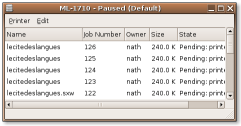
All I needed to do then was cancel the duplicate print jobs, and resume printing.
But Nathalie says she didn't see the icon. Thinking back to what Carole once said about how her parents used the computer, I realize that there's a big difference between what end users see and what somebody who has played with and built software sees.
Posted by Mark at 08:26 PM | TrackBack
September 25, 2005
Music for running, part II
 Still cannot tell how to determine what to listen to in advance. Make a Jazz Noise Here, disc 2, seemed to work pretty well at the end of a long, exhausted run.
At least Frank doesn't say anything meant to sound encouraging. There's a point near and after the wall where encouragement just sounds fake, especially coming from encouragers who are safely immobile at the side of the road. This is not to say I invite discouraging words. I'm just saying I'll hear whatever you throw at me with a sort of distorted social perception, and will only recover my normal sociability after I stop.
Posted by Mark at 07:14 AM | TrackBack
September 15, 2005
Abraham Lincoln and my legs
Abraham Lincoln was reputed to have responded to the silly question, "How long should a man's legs be?" with, "Long enough to reach the ground."
It turns out my right leg isn't quite long enough. Or maybe my left leg's too long.
Yesterday evening the podiatrist showed me my right leg is slightly shorter than my left, which explains the slightly asymmetric wear patterns on my running shoes. He also wondered if I had back problems, which I have had from time to time.
I used to think backaches came from being too fat and out of shape. Then when I lost weight, I thought it was my bed. Maybe a better explanation is mismatched legs.
The podiatrist is pretty sure he can fix the mismatch by adding a bit of extra thickness to the right orthotic insert of my next pair. Must go to the doctor's tomorrow to get the prescription I was supposed to have to go see the podiatrist, so he'll be able to make me the pair of orthotics. (Securité Sociale paperwork requirements)
Posted by Mark at 08:31 PM | TrackBack
August 11, 2005
Methane from Siberia
GuardianUnlimited published a special report about global warming hitting a tipping point, beyond which the process could accelerate significantly.
Some scientists suggest, "The causal effect is human activity." Some suggest that natural processes are causing it. (Whatever it is, maybe we should've had reversible heating/air conditioning installed upstairs instead of just heating ;-)
Posted by Mark at 01:03 PM
July 29, 2005
Jet lag
Jet lag invariably takes me to the psychological low point in the early nighttime of the second day. The worst I've had so far is stumbling through the Bay Area on foot in deep paranoia, a horrible place when you feel fragile. It's hard to believe so many people lived through LSD experiences in that environment when even jet lag nearly sends me hiding under the bed.
Yesterday after failing to get USB storage working, I tried to go to sleep, but could not. I started reading If on a winter's night a traveler, hoping that would help, but it was worse. Calvino was mocking me in every line.
I complained to Phil this morning about the censorship we practice from good manners, keeping our real opinions covered, partly out of the concern we'll be attacked for them, partly because we're too lazy to defend them. We accept nonsense silently, or even with a measure of complicity and consent. The condition is surely exacerbated during job interviews, guest visits, courting. Then we must live with our failure to speak our minds, like the liar who can no longer remember what tales he told.
Phil listened to my blabber and gently agreed, even offering an example of his own to corroborate my findings. Maybe he disagreed, I don't know.
By the time you're old enough to know what's going on, you're already straight jacketed in a context that's breeding it's own problems even before you add yours.
In a dream I met someone who was a mover and shaker. I'd asked, "What do you really want to preserve?" He replied, "Control." I woke out of that one shaking and gasping for breath.
Posted by Mark at 01:12 PM | Comments (2)
July 20, 2005
P & G and Satan
One of the things Dana had decided about the Internet was that the worst misinformation came not from dishonest WWW publishers, but from well-meaning friends and relatives forwarding email of the urban legend variety. A long time ago, he got one about Proctor & Gamble:
PLEASE MAKE A DIFFERENCE
The President of Procter & gamble appeared on the Phil Donahue Show on March 1, 1994. He announced that due to the openness of our society, he was coming out of the closet about his association with the church of Satan. He stated that a large portion of his profits from Procter & Gamble Products goes to support this satanic church. When asked by Donahue if stating this on t.v. would hurt his business, he replied, "THERE ARE NOT ENOUGH CHRISTIANS IN THE UNITED STATES TO MAKE A DIFFERENCE."
Googling to a writeup of this urban legend, in which you can read the full text of the email, I noticed the Google ad on the top left:
Proctor & Gamble Careers
Land your dream job. Search 900,000 job listings. Apply online now.
I guess if you're going to hell anyway, you'd better get a head start up the career ladder.
Posted by Mark at 03:09 AM
June 30, 2005
Love or confusion
This morning I woke up at 4:12 am with cramps in my left foot and the realization that God does not necessarily hate us. It seems possible that an omnipotent, omniscient creator could both love us and not take us out of the current situation. Metaphorically, God as Our Father stands beside his tormented children realizing that although, even because he loves us he must not lead us out of this box, but instead let us grow our own way out.
I'm not sure we can get out, but at least we're not necessarily doomed. Of course, I could be completely wrong. I'm very tired and my mind has been flaky.
That said, if you consider yourself an atheist and yet read this far, let me tell you this. Light can be understood as a wave, as a particle, and in many other ways. Concepts whose truth can be proved we call facts, and in this domain we're dealing with metaphors.
Posted by Mark at 06:32 AM
June 29, 2005
Religious
Dad sent around a link to a speech by author Michael Crichton delivered in 2003. Crichton sees the religion of environmental fundamentalism as a key stumbling block in the way of effective, scientific approaches to environmental problems. He also sees "politics" as another key stumbling block.
Rob and Luke laughed at me for enjoying Robert Anton Wilson's book, Quantum Psychology. Rob calls it, "Shit Psychology," in reference to the amount of horseshit you have to shovel through to get to anything substantive in what Robert Anton Wilson writes. Rob also laughed at Critical Path for some of the same reasons, something to do with dolphins. Rob believes in the Scientific Method, so he reads books by Russell and Feynman.
I reacted negatively to Crichton's speech. I don't have well-formulated beliefs about environmental policy, perhaps because I shy away from contact with the world outside ideas, instead remaining in a cool, dark corner of that cave, replaying the same slides with the old branding. I hate the Scientific Method, although I cannot imagine anything better. The hate seems totally irrational.
Rage comes out of a feeling I've had my entire life, a feeling of powerlessness and of being trapped in the same sense as the narrator of Kafka's Bericht für eine Akademie, yet with the eldest child and idealist stress of both infinitely high expectations -- there are only failures -- and the pressing need to do something about it. That rage drives my extremism and my revulsion. Sometimes it also drives reserve and compassion, since most other people must also be islands of horrible suffering.
When I look at the situation from outside, it's positively hilarious. Psychological slapstick.
At another level, it's another interesting engineering problem. That makes at least two:
- What fits better than rule of law?
- How do we think straight?
Mark Williams observed years ago in Vaihingen when he was studying at Stuttgart and I was farting around that engineering looks out at the world to solve problems in the hope of finding a better fit, and that the Buddhists decided instead to look within and solve problems in the expectation that if you get yourself straightened out, the world will follow.
It occurs to me here on the floor of my cave that in wondering which to do, I'm doing neither.
Posted by Mark at 06:20 AM
June 26, 2005
Revisiting the rule of law
Geoff Arnold blogged in consternation about those of us who run red lights and stop signs when cycling. The comments ranged from, "We have laws about this and these folks should follow them," to, "Why in the world should I allow this law to dicate my behavior in situations to which it very obviously does not apply?" All of that can be debated, and was, in the context of cycling within or outside of the rules of the road.
Rob and I had an equivalent discussion at work the other day about standards and conformance in software, with the specific context being management frameworks. Agreements always seem to break on the equivalent of cyclists running red lights. The thing is, most of the cyclists doing that agree in principle with the laws they're breaking. Had they taken part in establishing the law, they'd probably have come to the same conclusions as the representatives who voted on the text.
In places outside the US, like France where I live, there's a fatalistic acceptance of the gulf between theory and reality. As a result when French officials came up with a plan to reduce the number of traffic accidents on French roads, they decided simply to more strictly enforce existing laws and begin a huge scare campaign. The results were dramatic reductions in the number of people dying and getting injured on the roads. So you can more effectively force application of the theory...
...but when there's an alternative, people will opt out. Even in areas of high population density, we've managed to make commuting with the car almost inevitable. A crackdown therefore breaks people, forcing them to behave according to the law. It won't work as well in situations of choice. Yet that's exactly where we want to arrive at protocols, agreements on how we'll operate, that must be respected voluntarily.
Jon Bosak may say we can get to such agreements following Robert's rules of order. What we do, however, is come up with rule of law plus bodies of legislation. Then we find situations where specific legal prescriptions do not apply, and otherwise upstanding members of the community become temporary outlaws.
Would increased participation be enough? In other words, am I more likely to respect a law I personally had a hand in devising? If you'd answer unequivocally, "Yes," to that question, do you do it when you write software? Or do you tend to want to adapt your design ever so slightly when you're coding?
The rule of law seems to be a good approximation to the right system. Yet it also seems to break in ways that suggest the design is fundamentally flawed.
Posted by Mark at 08:00 AM | Comments (4)
June 15, 2005
Drop out
Wired says Steve Jobs told Stanford grads dropping out was the best thing he could've done.
"Your time is limited so don't let it be wasted living someone else's life," Jobs said to a packed stadium of graduates, alumni and family.
I'm sure Steve says that to all the people who work for him. "Don't waste your life doing what I tell you to do."
Cross this with What You Can't Say from Paul Graham, which Geoff Arnold blogged about Monday.
Nerds are always getting in trouble. They say improper things for the same reason they dress unfashionably and have good ideas: convention has less hold over them.
Paul, that's mythology. Most nerds have accepted the blinders, probably more than people emptying garbage cans. Sure, they get to show up for work at 11:30 am wearing clothes almost studied to say, "Look at this. I'm so outside the box." Most nerds probably also accept a lot of crapola outside their domain of expertise. We're happy when a product we worked on sells, even if it's directly to the military. We watch the news, filters off, sitting there gobbing every drop of that raging torrent of sewage. We buy iPods.
Geoff Arnold quoted Paul Graham, "Let's start with a test: Do you have any opinions that you would be reluctant to express in front of a group of your peers?"
I guess that's a test to see whether you've had a lobotomy. My wife once had me take homeopathic medecine that was supposed to help me let it out. That medecine seemed mainly to make it easier for me to be grouchy. Paul writes:
The problem is, there are so many things you can't say. If you said them all you'd have no time left for your real work. You'd have to turn into Noam Chomsky.
It's true, Noam never got any real work done in linguistics before he flaked off into doing the lecture circuit as a scholarly anarchist. We'd better stay clued in, graduating through the hoops, even if Paul says we shouldn't. Ain't that right, Steve?
Posted by Mark at 09:03 AM | Comments (2)
May 17, 2005
Mont Caume
Thought I could ride up Mont Caume after running. Riding around here is odd, all uphill and downhill.
Got halfway up Mont Caume on a lumpy little road and reached the 2 km marker. Then I saw the summit shrouded in clouds and started feeling cold. It was 8:05 am. So I turned around.
Starting back down turned out to be downright scary with loose brakes and steep roadsides. Had the feeling I'd had years ago when climbing too far up a tree. Then I realized I could walk down with SPD shoes. So I got off the bike and enjoyed the view of Toulon and the Mediterranean.
Posted by Mark at 09:20 PM
May 10, 2005
Headache, part XII
The chiropractor asked me how much milk I drink. He says we lack an enzyme necessary to finish digesting cows' milk in the intestine, and so the liver and potentially other systems have to finish the job. He told me that it can even prevent the body from recovering after training, meaning training becomes less effective. It can also lead to troubles processing other irritants, meaning milk products can be linked to allergies.
So he suggested I consider backing off on milk products while training. I asked him about calcium deficiency. He said not to worry much about that, because the body cannot get the calcium it needs from milk products anyway, due to the difficulties of digesting milk. I'd do better to eat more fish, shellfish, nuts, and fruit. He also suggested I aim to eat carbs that have been processed less, such as brown rice, or whole wheat noodles.
He also looked at the x-rays, and at the prescription for physical therapy. He said it probably wouldn't help me in the long term.
Then he examined my neck and back, finding tight spots. So he performed some manipulations on my spine, which made knuckle cracking noises. Then he examined my neck and back again.
The effect surprised me. I can now turn my head all the way to the left without resistance.
He told me "pas d'efforts" tomorrow. If I feel good Thursday, I can go for a short, gentle run, but nothing hard for 48 hours. I was feeling slightly intoxicated somehow after the visit.
By the time I got home, my head was hurting, however, as were my neck and shoulders. Nathalie says it's normal. Her body always reacts that way after she sees the chiropractor.
Posted by Mark at 09:09 PM
April 28, 2005
Competition
During today's ride, by the way, Matt left me in his dust halfway up the hill in Bernin. As we were rolling through Crolles he said, "Ready for the hill in Bernin?" I didn't realize he was throwing down the gauntlet until my heart rate had gone up 10% and was still climbing.
That's was the only stretch today where we rode hard in fact, but he pushed me to ride harder up that hill than I ever have before. If I want to get as good at riding hard as he is, I have lots of training to do. He may have been paying me back for having pushed past him on the steep part of the hill to Rochasson a couple of months ago.
It was a relief to see the sweat dripping of his brow when he slowed and I caught up. Funny how a little competition can push you further that you'd go on your own. Think I still want to get better at running before I switch to cycling, though.
Posted by Mark at 07:55 PM
April 25, 2005
High standards
In reading Bainton's biography of Martin Luther, I'm impressed by Luther's high standards. He set his sights on Christ as his role model, knowing that he'd never approach Christ's good mind or even his good deeds. Even though he knew he was doomed from the outset, he never lowered his standards because even though he'd never get there, he knew through faith that God's grace would take up the slack.
A reassuring facet of the biography is the regularly repeated episodes during which Luther is wracked with doubt. The doubt makes Luther's unwillingness to compromise his high standards one iota more human. You can almost imagine how hard he was training.
Posted by Mark at 02:51 PM
April 18, 2005
Pushing back the wall
In reading Guide nutritionnel des sports d'endurance I learned that anaerobic metabolism of glycogen is 12 times less efficient than aerobic metabolism.
So any of the time I spent going too fast in the cold rain from kilometer 5 to about 25 was also destroying my reserves at an outrageously high rate. A bit more efficiency might result in a huge boost the last few kms.
Posted by Mark at 01:59 PM
April 15, 2005
Too much water
Both Mom and the DRS list noticed the NYT article saying some runners are drinking way too much to avoid dehydration, and are actually putting themselves into danger of having too much liquid in their systems. People have died from swelling their brain cells with water.
"Drink before you're thirsty" is right. "Guzzle gallons whenever possible" is silly.
Last summer I ran half-marathon distance when it was 34 C (93 F) outside. It took me about 90 minutes, and I did it without drinking. That was stupid:
At 1:01:30, I was feeling pretty thirsty. At 1:15, I was drying out. At the end, I was sweating less than when I ran 10k yesterday, even though today was hotter. Need to figure out how to take some water for runs that long.
That day I should've been drinking something. But that doesn't mean I'm going to go out Sunday and drink a liter of water at every stop. My aim is more along the lines of 20-25 cl every 5 km. That works out to 1.6-2 liters over the marathon distance. If I lose 1 liter/hr, that means I'll be 1 liter down over the whole distance. So if I also drink in the morning, then a glass of something right before going out, then a little bit after the race I should be fine. Even after running hard for over 20 mi, my kidneys were functioning normally by lunchtime.
Posted by Mark at 09:12 PM | Comments (2)
Reading, writing
Emma's learning to read and write now that she's 6 years old. Last night she was reading part of the bedtime story. Tonight she's typing on the other computer:
moto 16 emma timo avril 2005 diane papa mamam
She's running out of things to type, she says.
Posted by Mark at 08:24 PM
April 10, 2005
Crafts, part II
Nathalie had Tim learning lace and Emma learning to sew decorations onto the purses Mick and Jeanne sent for her birthday.


Emma did all three today, really applying herself. Tim was proud of his first lace bookmarks.
Posted by Mark at 05:55 PM
April 07, 2005
Gossip
Andy mentioned gossip in an email. That made me wonder.
Is gossip a way of building community? Gossip is, "Notorious for the introduction of errors and other variations into the information thus transmitted." (Source: Wikipedia) But it certainly binds people together. My wife's interrupting me with some right now...
Posted by Mark at 08:35 PM | Comments (1)
March 31, 2005
UNIX, Sherlock Holmes, the moon
Although I never read the original story, Sherlock Holmes apparently once summed up his approach to knowledge for Dr. Watson. Holmes's approach fits the mentality of good hackers, and explains some of what seems weird to people on the outside looking in.
Watson was astonished at one point to learn that Holmes didn't know whether the moon went around the earth or vice versa. Holmes of course said it was elementary: why bother to try to fill up his head with things he didn't need to know.
Posted by Mark at 04:38 PM
March 30, 2005
Back tire
Racing tires do not seem to last very long. After riding Monday, I noticed the inner tube peeking through the sidewall of my rear tire. I also notice a couple of cuts in the surface that looked deep and relatively new.
So today I replaced the rear Michelin Pro Race tire with another. This one has gray sidewalls, meaning it's reinforced with Kevlar. The real problem may be that I need to lose 20 kg in order to be a light enough rider for a fussy racing bike.
I also noticed that when rolling on the freewheel my rear hub rotates slowly and very slightly on its axis. It should not do that, right?
Posted by Mark at 08:21 PM
March 21, 2005
Real work, part III
Nathalie told me when I got home that she'd taken the car to the garage. The problem was a bolt on the front left wheel that I hadn't tightened enough, causing the other three bolts to come loose. Had she removed the hubcap, this would've been obvious, which reminded me of the time she ran the car until there was no oil showing on the dipstick at all, then took it into the garage when the light came on.
The mechanics of the car are, by definition, not her problem. To the auto industry's credit she mostly gets away with it.
We'd like to do that in software engineering, too. Maybe in a few years we'll get as close as the auto industry. Maybe we'll still be doing it like we are today.
Posted by Mark at 08:30 PM
March 18, 2005
Addition and multiplication, part II
Tim tried his first set of 20 addition exercises. We decided he should be able to do 10 a minute at least if he really knows his stuff.
The good news is he got the first 16 right. The bad news is that it took him two minutes to do 16. Will have to drill him until he memorizes single-digit addition.
Posted by Mark at 09:09 PM
March 17, 2005
Addition and multiplication
Tim's having some trouble with arithmetic at school. He ended up learning to read early, so they had him skip a grade. But he wasn't that far ahead in math even as he missed the year where they learn to add. So he still counts in order to add single-digit numbers.
Nath and I plan to use worksheets found on the web and gold stars or something equivalent to get him trained. He'll have the same problem I did. I hated multiplication tables because you have to memorize the answers. Working the answers out from basic principles takes too long, yet there's enough that you actually have to work at it for a little while. Anything longer than instantaneous was too much for my willpower.
On the other end of the spectrum is UNIX, which is like learning to read a language where the alphabet has 100,000 letters. Why don't I hate that?
Posted by Mark at 08:57 PM
March 13, 2005
Lire, part II
What's next? I'm having trouble solving this one for x, y:
(speaking, writing, y, ...) <==> (listening, reading, x, ...)
Any ideas?
Posted by Mark at 08:11 AM | Comments (2)
March 08, 2005
Censor thyself
Somebody from C|Net must fear their advertising will go away if people in tech continue to blog about their work. Their FAQ: Blogging on the job reminds you:
Can my employer fire me if I blog from home on my own time?
Yes. The odds of your company perusing your blog is slim. "But if your boss should see your blog and be offended by something there, in most states you have virtually no protection against being fired."
Frank, if you have time to read this, you don't have enough work to do. Let me give you some of mine.
Don't worry. We auto-censor ourselves anyway. But check out this decision allegedly by a federal judge in the US:
The FBI theoretically could also issue a (secret request) to discern the identity of someone whose anonymous online Web log, or 'blog,' is critical of the government.
Isn't that heartwarming?
Posted by Mark at 09:19 PM
February 28, 2005
Kafkaesque
John Gilmore cannot fly because he won't show ID. PostGazette.com is running an interesting article on his skirmish with the government concerning security regulations that you have to take on faith because they're not disclosed.
Posted by Mark at 09:38 PM
February 27, 2005
Polar fritz, part II
My heart monitor screen went blank again last night. It happened when I took off a polar fleece top that crackled with static as it slid along my body. The Polar A3 may be sensitive to static electricity.
Posted by Mark at 07:58 AM
February 20, 2005
Beliefs
While gathering papers for the 2004 tax declaration, I came across a Christmas card Mom found in Grandma Tuenge's stuff. The card was from me, saying that I had prayed, asked Jesus back into my life and wanted to do God's will. I wrote about being "entrenched in my own mess."
What the perceived mess was then, I cannot recall. From a distance it looks like I was inside the punch line of a Zen practical joke or a Kafka parable. I'm still working to dig my way out of the trench.
My belief in God never seems to give in to anything, even the belief that I've had for the last few years that I'd be better off eliminating beliefs, looking instead for evidence and plausible explanations. It won't even give in to the incapacity to explain what I mean by believing in God. Maybe the belief came from my family, early enough that I cannot remember any time before it. Maybe it came from God.
Richard Dawkins suggests God is a long-lived idea, particularly fit to survive in the world of ideas. He cites God in his explanations of memes, which like genes replicate. Memes reproduce from one human mind to another. His explanation holds up fine as long as you stick to the argument and don't try to get an understanding of what's underneath. In mathematics you're fine as long as you stick to the relationships and don't try to understand what 1 or 0 "really is."
Maybe that's what I should focus on, what God "really is." That ought to stretch my mind. Perhaps it would work like Matt claims running hard works, where eventually your body gets better at going faster so it won't have to work as hard.
Posted by Mark at 03:46 PM
February 09, 2005
Going the distance
Last night and this morning I began reading Hal Higdon's book Run Fast. At about chapter 3, Hal suggests running two 90-minute endurance runs per week to improve your speed. Okay. But then my winter training, based on Hal's first-timer training program for a marathon, does not include enough long slow distance to speed me up. There's a lot of foundation-building to do before I'll be able to go the distance at a fast pace.
I'm glad I didn't start reading this book before now. Might have been discouraged.
Posted by Mark at 08:10 AM
January 22, 2005
Patience
Matt teases me about sticking to Hal Higdon's novice training program for marathoners, with only a little extra cross training. Hal writes advice like, "Don't be embarrassed to stop and walk briefly. You may need to do so in the marathon." Matt was retelling me the story of Tyler Hamilton who broke his collarbone, but didn't want to let the other riders know he had a weakness, so he just dealt with it. At the end of the ride, on which he did okay, he had to have reconstructive dental surgery because he'd ground his teeth to stubs biting down the pain. Matt says although I'm a first time marathoner, I shouldn't be following a program for grannies with heart conditions.
Part of the why I'm doing a marathon is because I'm not competitive. I plod along, more of a tortise than a hare, even if I'm an excitable tortise. Another reason I'm doing a marathon is that it's a long run event, not a mad dash. The longer you want to maintain it, the more you can win with strategy and persistence rather than tricks and attitude.
Of course you shouldn't believe me. I haven't even run a marathon yet. But you might be willing to consider Tor Aanensen. No teeth ground to stubs, just plenty of patient training. When he first ran at about age 30, he was no great shakes. His first race six years later was a 15 km affair that Tor ran in 1:07. But by age 48, he ran a personal best of 2:27:38 in the 1987 Berlin Marathon.
If you're not sure what 2:27:38 means, try it. That's a sub 3:30/km (5:38/mi) pace. Don't be embarrassed to stop and walk. You may need to do so.
Posted by Mark at 11:42 AM
January 21, 2005
Paroles de chansons
Several years ago someone gave me a CD of actresses singing in French. At the time, my French was not good enough to understand everything. It has improved since then. Je comprends au moins les paroles.
In the controlled vocabulary of work, I feel comfortable if brutish. But I'm still hit or miss at conversation, like running in combat boots. Can be done, but tough to do elegantly.
So I'm lucky to have met my wife in a third language neither one of us speak well. I'd never have managed to seduce her otherwise.
Posted by Mark at 09:23 PM
January 05, 2005
Max. heart rate
According to the Sports Coach Maximum Heart Rate Stress Tests page, I shouldn't have gone out to check my max. pulse today, since I was ill only last week. Oups.
Anyway, I'm going to pretend that my maximum heart rate was the rate I saw today when I stopped sprinting, 195 bpm. According to my heart monitor, I now have the heart of a 25-year-old guy.
My wife probably wishes all of me were in that kind of shape. In fact, it's a fluke. Dana said Mom's resting heart rate is quite high, around 90 bpm. I inherited hummingbird genes.
Posted by Mark at 09:17 PM | Comments (2)
December 29, 2004
Words, part IV
Lately this blog has focused mainly on endurance sports. If procrastination were a core activity, I'd have a hard time getting around to it. Unfortunately for me, it's peripheral, and thus consumes nearly all my energies.
Realizing this, I went back briefly this morning to thinking about getting a real job. It turns out that one of the two US schools I checked out, University of Illinois, has a distance learning program for the MS. They call the program LEEP.
I listened to Christine Jenkins's account of teaching course 406. She seems to have done a better job than most of our phone conf leaders. According to her, anyway. I don't know if they managed to measure students' performance afterwards somehow. My experience with long-distance synchronous communication is that at least part of the assembly engages in what Bill Joy called multitasking.
In information science, multitasking refers to running more than one program or at least thread of execution at the same time. That is, doing multiple things at once. Computers handle multitasking by storing program context in fast memory and switching quickly between tasks. Each time the computer changes tasks, it switches context. To the human being, the computer switches so rapidly it appears to be doing multiple things at once. (More recent chip designs allow computers to execute multiple threads in hardware. Computers with such chips, and computers with multiple chips, do in fact run more than one program at once.)
Bill Joy apparently convinced Scott McNealy that he could multitask effectively. So Scott let him read magazines during their staff meetings. My take is that Bill observed Scott and his staff enough to be able to predict appropriate behavior with only a few clues, and that Bill was a smart guy and fast learner in that type of setting anyway. He therefore didn't need to concentrate his full attention on meetings he found unnecessarily repetitive.
Dana does multitasking as well. He'll typically read the paper at the same time he watches television. Most parents do multitasking. They let the children do what they're doing, checking mainly for boundary conditions while actually doing something else.
I contend that whatever your level of effectiveness when multitasking, it's less than your effectiveness when monotasking. The more human beings need to grasp something difficult, the more they need to concentrate.
We find concentrating amazingly hard to do in practice, however. Mom seems to be able to do it while reading. If you call her name and she doesn't respond, the story's pretty good.
Mustering the same lack of distraction to follow something online requires more than dedication. Going to class over a browser and Real Player sounds tough. The asynchronous part I'm sure I can do, though. Worked fine to get a BS in Computer Science.
It's reproducing the "classroom" experience that leaves me dubious. We're a long way from The Age of Spiritual Machines.
Posted by Mark at 08:53 AM
December 28, 2004
Heart rates
I'm reading at MarathonGuide.com:
Some trainers recommend that runners should not run two consecutive days over their 70% level, setting that value as the ceiling for recovery days. Most agree that hard days should be run at the 85% level, if not higher.
This would suggest I'm working too hard too often. If on a day like today -- an impromptu cross-training day during an "easy" week -- I spend 1 3/4 hours at 83% level on average, my body may not have time to recover enough.
A Runner's World article says:
Your aerobic training pulse is important because it's the pace at which you should do approximately 80 percent of your weekly running, including easy days and long runs.
The trouble with my adaptation of Higdon's novice training program is that I doesn't involve enough exercise in the beginning to keep me from feeling antsy.
Need to stick with it, though, reducing the intensity of the exercise if necessary. Even worse than underexercising is getting injured then not being able to exercise at all.
Posted by Mark at 03:19 PM
November 29, 2004
Video capture, part VI
The SVCD I burned doesn't work on our livingroom DVD player. It might work on Mom's, however. Too bad I have to send the thing over there physically to try it out.
Posted by Mark at 10:52 PM
November 28, 2004
Words, part III
In addition to their being possiblities to do at least a Master's in library science without leaving my current job, maybe my current job isn't that many fields away from actual librarian jobs.
I've been reading this morning about Endeavor Information Systems, who sell library management software. And in looking through the job ads at the Association of Research Libraries, I saw one titled "Unix Programmer," somebody to hack the metadata systems at Brown University.
Posted by Mark at 07:55 AM
November 25, 2004
Reading the doc, part III
At the outset of Leviticus, I had the option of switching to a book Andy mailed me, The Story of Christianity: Volume 1. The Early Church to the Dawn of the Reformation, by Justo L. Gonzalez. Leviticus starts by describing how to make burnt offerings, and feels kind of repetitive in the beginning, so I switched.
Gonzalez's book is interesting from the beginning, but I found Chapter 9, "The Teachers of the Church," especially good. Gonzalez writes about the work of Irenaeus of Lyons, Clement of Alexandria, Tertullian of Carthage, and Origen of Alexandria. All address the whole body of Christian doctrine with somewhat different approaches.
Posted by Mark at 09:14 PM
November 15, 2004
Words, part II
In my musings about going back to school I forget to note that I might be able to do it without leaving my job.
After all, I've already done it at ACCIS, where I got my Bachelor's degree in computer science. That represented plenty of work in evenings and on weekends.
Certainly it wouldn't make sense to try that for a doctorate, but it might work for a Master's. Something to consider as my objectives become clearer.
Posted by Mark at 08:58 AM
November 11, 2004
Words
At some point I will be able to stop working as a technical writer and go back to school.
Why? It's hard for me to answer the question, because ending up back at school seems so naturally right that I've never thought critically about it. Perhaps school fits my natural laziness. It's something I've been able to do well in the past. It hasn't been hard work yet. Of course, I've only done Bachelor's degrees (and one Maîtrise here in France). I've only partially rediscovered what others painstakingly researched long ago. They walked, then took leaky boats which they had to repair themselves during the voyage. I took commercial airlines, ate reheated meals on trays, and watched the in-flight films.
I've been working for 8 years at this point, perhaps getting even dumber and slower than I already was. Was my thinking always this dull? I cannot tell for sure. It probably was. Unlike a real writer, I don't have a need to write. (I do have a need to read. I also have a need to eat with no corresponding need to farm, hunt, gather, whatever.) Maybe I don't have a need to tell stories. I have however developed my ability to withstand drugery. My ability to withstand drugery is still quite weak compared to that of other people, but you should see how bad I used to be.
Where would I go to school? That depends on what I'd do there. Nathalie and I have been talking about vacation. This led me to ask the question, "What is your dream vacation?" She didn't answer. I realized then that a central divertissement in my dream vacation is a large, research library. The place is quiet. You feel a sentiment that you'd never run out of new books, the sated pleasure of wallowing in a mountain of precious volumes like a dragon in his lair. This research library, maybe during school vacation, I imagine near good places to bike, run, eat, and also near a functional hotel or appartment, somewhere that doesn't butt in on enjoyment of life with chores like raking leaves, clipping hedges, painting, and changing the oil.
How do you end up spending more time around a research library in real life? Well, you could do research. You could work there. Maybe you could work as a librarian, doing research yourself or helping other people to do research.
Googling distractedly, I find a couple of top-rated library science schools in the US. One is SILS at UNC. Another is GSLIS at the University of Illinois. One of the top rated schools here is near Lyon, ENSSIB.
The application for SILS requires of the applicant a, "Brief essay expressing why the applicant is interested in information or library science as a career (500 words maximum)." Hmm. I take that to mean they don't want people who've come to wallow in books, and only realize secondarily they must somehow earn their keep.
The first definition of "career" at Google doesn't mention money:
the particular occupation for which you are trained
(source www.cogsci.princeton.edu/cgi-bin/webwn)
It's probably a good thing they don't mention money, since the pay is no doubt lousy. Google leads me to $34,901 average starting salary in 2000. That sounds like school teacher range. Furthermore the university towns where they keep the research libraries are typically expensive places to live. I think of my brother in Ann Arbor, for example. Hmm.
On the other hand, I started out for much less than that in Paris, and 8 years later have managed to get myself into a situation where the bills are so high $35K immediately conjures sensations of starvation and cold. Dismal starting salaries alone therefore shouldn't stop me.
I pause to imagine a world without "ravenous carnivore" salespeople around like the ones we're apparently trying to hire to hawk our (hard and soft)wares at work. In my innocent imagination, a library, like a church, is a place where people are fairly reserved, lost in their thoughts and investigations of other peoples' thoughts. Money might be an object of study, but not a direct consideration. It's not just a dragon's lair. It's an ivory tower.
Anyway, pursuing a career is simply doing that for which you are trained as an occupation. I guess that's better than what I've been doing, which is a lot of stuff for which I've not been trained. So why am I interested in information or library science as a career? More specifically, why am I interested in library science as a career?
Hmm. At this point, I realize that I don't really know what a librarian does. Guess I need to learn about that.
Posted by Mark at 03:38 PM
November 03, 2004
Problem solving
At work, several of us are taking a course in problem solving. After a good day yesterday, I felt uncomfortable all afternoon. Borges wrote (Alastair Reid's translation):
It is no exaggeration to state that in the classical culture of Tlön, there is only one discipline, that of psychology.
We've discussed problem solving for two days. We tried exercises involving square doughnuts, contaminated film, incident sensors in a bank. I doubt we'll cover any case studies involving psychology.
Posted by Mark at 09:20 PM
Procrastination
InformationWeek ran an article on Steve Ballmer's explanation of how Windows is cheaper than Linux, which begins:
Which operating system, Linux or Windows, is cheaper, more secure, and lower risk? Countless hours have been spent debating the question...
With so many real problems in the world to solve, why do we spend countless hours debating generalizations such as these? Does the answer lie in a proclivity for procrastination? How much would putting things off explain?
Posted by Mark at 07:55 AM
October 25, 2004
Revision
Why revise? You tell me that all quality resides in forthright revision, that glinting passages, even whole shining nuggets, can only be found, not brought forth whole.
But I'd tell you there's no point panning for gold flakes in this muck. This is the literary equivalent of small tallk we make to keep each other at arm's length.
Words keep me from conveying what's really on my mind.
Posted by Mark at 07:41 AM
September 20, 2004
Voting, part II
Well, I looked around a bit more and have decided to cast my vote with the Pansexual Peace Party.
I hereby appoint myself the Party's presidential candidate. If elected I promise not to spend it all in one place, and to read the US constitution at least once all the way through.
Posted by Mark at 10:29 PM
Voting
I'm not sure who I ought to vote for in the US presidental election this year, so I asked Google.
Typing in "Who should I vote for?" and clicking I'm Feeling Lucky brought up a page entitled Why Christians Should Not Vote for George W. Bush, written on 15 February 2004 by Dr. Patrick Johnson. Dr. Johnson concludes that Bush's record shows him to be far too liberal (that is, left wing) to deserve Christian votes.
Dr. Johnson seems to suggest that I vote for the Constitutional Party candidate, who according to their site is Michael A. Peroutka.
Mr. Peroutka stands for God, Family, Republic. In fact, the Constitutional Party posts a mission statement. This one's a little clearer than some of the others I've seen lately:
The mission of the Constitution Party is to secure the blessings of liberty to ourselves and our posterity through the election, at all levels of government, of Constitution Party candidates who will uphold the principles of the Declaration of Independence and the Constitution of the United States. It is our goal to limit the federal government to its delegated, enumerated, Constitutional functions and to restore American jurisprudence to its original Biblical common-law foundations.
Hmm. I'm glad Google resolved this little question for me in such a straightforward manner.
Posted by Mark at 09:54 PM
August 30, 2004
Patching cognitive dissonance
Do those who handle high levels of cognitive dissonance survive more effectively? Does some level of cognitive dissonance lead to enlightenment?
Posted by Mark at 10:39 PM
August 26, 2004
Learning Python, part II
My brother knows more Python than I do. He can probably still recite the entire cheese shop sketch.
Yet I know marginally more than I did. Learning Python went down more smoothly than K&R, for example. I wonder if I should try coding a schema repository in Python rather than Java.
Posted by Mark at 06:20 PM
August 22, 2004
Back to school
The children go back to school next week.
Dad asked me what I'd go to if I had to leave Sun at some point. His first suggestion was venture capitalist, but I don't think that one fits me.
I'd probably go back to school. But this time I'd go pay a bunch of money to teach myself without much help. First I need to research potential research topics. My research topic would probably involve researching better ways to survey topics and determine what we already know or have tried to know about them. Sort of researching part of research.
I read Larry Wall's State of the Onion yesterday. Finally understood that you could refer to what he calls laziness as elegance. Mind opening in a subtle sort of way.
Posted by Mark at 10:44 AM
August 12, 2004
Faith
Losing faith in authority is like losing your virginity.
Not something you can get back. Would you want it back if you could get it?
Posted by Mark at 07:46 AM
August 11, 2004
Childlike understanding
A child-like man is not a man whose development has been arrested; on the contrary, he is a man who has given himself a chance of continuing to develop long after most adults have muffled themselves in the cocoon of middle-aged habit and convention. (Aldous Huxley)
What if you were already a nearly middle-aged, nailbiting, creatively nonconformist wannabe navelgazer as a child?
Posted by Mark at 09:39 PM
July 31, 2004
Democracy inside
If democracy means "Participation by the mass of people in the decisions that shape their lives," what would it feel like to treat your body as a democratic organization?
Posted by Mark at 02:30 PM
July 14, 2004
VCD working
For partial closure of the VCD story, let the record say Mom has long been playing the first VCD in her DVD player. She agreed to attempt to record the content on cassette for Granddad.
Posted by Mark at 06:42 AM
July 08, 2004
videoconv.sh, Part III
Maybe it's my DVD player.
I've burned another CD, this time in SVCD format. The parameters must be close to right, and it of course looks fine in mplayer.
When I put the CD in the DVD player to watch it on television, the player cannot recognize the CD content.
Posted by Mark at 06:34 AM
July 05, 2004
Bad wine?
Mom wrote:
> How do you know if a wine is bad? Just because it tastes
> like vinegar?
I used to wonder, too. Then one day I opened a bottle that had gone bad.
When that happens, you find the distinction less subtle than you perhaps originally imagined. I wonder if the mystique of subtlety surrounding wine arises from the difficulty we have describing tastes and smells.
A way to look at this is to say, "How do you know if a tomato is bad?" Tomatoes resemble wine in a way. They're both produce. They both may improve with age. They both can go bad. We've all had a tomato that got moldy. Some of us didn't notice and we ate a bite. That's the experience with a wine that's gone bad.
We've also eaten disappointing tomatoes that hadn't gone bad, but had no flavor, had disagreable flavor, or had a mealy texture. We've also probably eaten a few tomatoes that made us say, "Wow! That tomato tastes delicious."
Wine seems similar. So setting aside wine that has gone bad like a moldy tomato, I would say you know a wine is bad if it doesn't taste good to you. That explains as well why you want to taste wine before you buy it.
Posted by Mark at 08:43 AM
July 03, 2004
(S)VCD
Now that I have libpopt.so.1 and a working system again, I got the sources to vcdimager 0.7.14, compiled that, and started looking at creating an SVCD, which Fabio says ought to solve my problems. He figures I probably goofed somewhere along the way of creating a VCD manually. Plus VCD quality is lousy.
I got the conversion started. It was working at something like 10 dv frames per second. The 00:21:21;26 of NTSC video to convert includes 38418 frames, however. Don't feel like waiting an hour for that right now. We'll see perhaps tomorrow night.
Posted by Mark at 06:50 AM
July 02, 2004
Video saga
Having run out of time yesterday at work to prepare a fix for my blunder, I'm still working in degraded mode. I thought I could perhaps create an SVCD from 5 GB of video, but so far have not been able to do so. The problem: lack of space.
I need to join 6 video segments into one long segment. I have just enough space to fit all sources on my Windows partitions. At first I thought therefore that I should just bring over what I need each time I want to append another source to the joined segment. But that means I'd still need space for an extra segment. Rummaging around to see what I can squeeze...
...maybe I can find time to repair my Red Hat installation soon.
Posted by Mark at 06:53 AM
June 27, 2004
Shooting without a story
Just captured 23 minutes of climbing and related shots.
Shooting as if watching watching, shooting without a story, makes for tough editing, I can tell that again already. We didn't for example shoot anybody looking up at the climbers. We also missed shots of the climber reaching his goal, which he did several times. We didn't shoot the wall very well.
We also had lots of badly framed shots and jittery shots with the person filming either yelling suggestions to the actor, or commenting the action. What I learned from Rubin's observations and from watching our own rushes, can be summed up in two rules:
- Don't move the camcorder
- Don't participate
Shooting according to these two rules feels odd at first. You find yourself in an editing frame of reference. You do not also exist socially in the film. It resembles writing about software more than blogging. Both you and the reader look on as observers and partners. Each time you tell instead of show, you interrupt and bother your partner. Each time you show instead of tell, your partner gets it almost telepathically.
Posted by Mark at 07:24 AM
June 20, 2004
How do I export it?
Kino cannot export digital video back to my camera. At least I cannot figure out how to do it. I mailed the developers for help, but this is definitely a blow I was not expecting.
So in disgust I saved my movie as AVI and wiped 14G of captured video from my disk. I'm sure I'll regret it. Or at least someday figure out how this stuff works. Maybe I should give up and start saving for a Mac.
Posted by Mark at 03:10 PM
June 19, 2004
First VCD
I've created a first VCD, mainly of the time around Tim's birthday this year, and of our trip to see Fred and Virginie in Osny.
No frills. Not even titles. Or French dubbed into English ;-)
Worse, it won't play in our DVD player, although it plays on the computer just fine. I'm hoping that the trouble lies with NTSC vs. PAL, and so will send this one back to the US anyway. Cross my fingers.
Posted by Mark at 07:45 AM
June 18, 2004
Trying to create a VCD
When I asked Fabio how you split sound and video with Kino, he just looked at me and said, "For that, I use a Mac."
Basic editing with Kino works quite well, even for a newbie. Trouble comes when you want to start coloring outside the lines, and most instructions you can find look like back-of-the-napkin notes by somebody who's intimate with multiple multimedia formats at the I-can-read-that-file-in-hex level.
So I've compiled all the tools necessary. I hope. We'll see if I manage to make a video CD from my 23 minutes of newbie-edited footage.
Posted by Mark at 10:31 PM
June 16, 2004
Library of Babel
Jason Ryder wrote about Blog Taxonomy about a year ago, but using Bloglines for only a couple of days has made it clear that it's hard to determine in advance what blogs you want to read.
Gideon Rosenblatt says in this Taxonomy Primer entry, that taxonomies faded a bit as full-text search technologies, "matured to the point when they became really useful." Taxonomies are allegedly coming back -- I know we're using them inside Sun. But even if we do solve the problem of shifting contextuality so those who know what they want to retrieve can find it more quickly, how the heck do we help ourselves when we don't know what we want to retrieve?
Trial and error. All I need to find what I didn't know I was looking for is infinite time. Or it'll be like the rest of the web, and infinite monkeys will eventually reduce the number of paths taken.
Posted by Mark at 05:06 PM
Distance learning
One of my degrees came through distance learning. I learned by reading and doing. Reading books and working out exercises either on paper or on a computer.
That should transfer easily to reading web pages and working out exercises, right?
I'm taking a course now in Launching and Sustaining Virtual Teams over the Intranet. And it's not working for me. I realize I cannot get myself to read a bunch of text online. When there's too much text on the page, I can barely get myself to read the first sentence before scanning.
Furthermore, the exercises are all of the form, "Answer these questions about your team," or, "Complete this worksheet based on your team and answer these questions." It's going to be a lot harder next time to convince me to take an online course.
Posted by Mark at 11:35 AM
June 14, 2004
First rough cut
After what seems like many hours, I've managed to cull and edit 70 minutes of raw footage to a rough cut of 25 minutes.

I'm too tired of it to watch it again right now, and probably still need to cut half again before it'll be worth watching.
Posted by Mark at 10:08 PM
June 13, 2004
Culling video
Given the way we shot footage when Mom first gave us the digital camcorder last month, it's hardly surprising how long it takes to mould it into something watchable. I'm probably not culling enough.
The video runs the gamut. We have everything from couch potatoes...

...to heavy jazz cats.

Rubin uses culling to refer to the process of throwing out portions of the raw footage so you can manage the rest. I'm searching for diamond dust in a mount of dirt. In 70 minutes of NTSC, you have 126000 frames to choose from.
Reminder to self: shoot less before editing.
Posted by Mark at 09:16 PM
June 09, 2004
No more oil, part II
96 euros. For 96 euros, he put premium oil in the car and told her it was up to me to check the level.
It felt like buying Microsoft phone support.
Posted by Mark at 08:23 AM
June 05, 2004
Learning JNDI
The JNDI tutorial covers almost too much for the LDAP developer alone. Like a good ski resort has everything from flat green slopes to bumpy, steep black ones.
I've run through most of the first 5 trails, though my understanding of security mechanism leaves something to be desired. The title of the last trail, Building a Service Provider, makes me wonder. How hard would it be to write a directory service provider abstracted away from the specific backend? If you then can use redundant, failover-ready, in-memory databases as the backend, can you eliminate the problems you'd have had using disks during LDAP operations? (Perhaps we're already virtualizing away from the actual disk anyway.)
Posted by Mark at 11:01 AM
May 31, 2004
Illiterate writing story
Working with Kino and the captured digital video from our new camcorder, I feel like an illiterate trying to write a story. No idea what to do to get something worth watching out of the clips I took. Garbage in, garbage out.
My only consolation is that the children's grandparents have been putting up with uncut video until now, so any improvements I learn to make should have huge impact to the quality of their viewing time.
Perhaps I could get this working as a webcam, I don't know.
Posted by Mark at 03:01 PM
May 28, 2004
First certification
This morning I took and passed my first ever certification examination, Sun Certified Programmer for Java 2 Platform 1.4. My score was only 47/61, or 77%, however. I wonder if I'd have done better had I taken the exam in February, just after studying the material for the first time. (I learned using Kathy Sierra and Bert Bates's Sun Certified Programmer & Developer for Java 2 Study Guide, on loan from Gordon.)
Ostensibly, in passing the exam you demonstrate that you know the Java language. I would refine that to say, know many of the basics of the Java language. Passing the exam still does not prove I know how to write a real Java program, and in fact, I've only written a couple.
So, in addition to perhaps brushing off what little I know of statistics, I may consider taking the developer certification exam, for which you actually do some programming. It would be cool to get back to the sort of hobby I had with WebMan and that I've let slide. (WebMan would almost be worth rewriting, but perhaps not quite.)
Posted by Mark at 02:11 PM
May 25, 2004
Understanding interrelationships
In continuing to reread Buckminster Fuller's Critical Path, which I now notice that I appeared to have reviewed at Amazon, where I complained that he told us, rather than showing us, what to do, it occurs to me that despite my BS in mathematics, I almost completely ignored a crucially important branch, namely statistics.
In Fuller's world, principles describe interrelationships in aggregates of observations. The science for studying principles of aggregates of observations we call statistics: "a branch of applied mathematics concerned with the collection and interpretation of quantitative data and the use of probability theory to estimate population parameters" (source: Google search).
What a shame that I did not choose to learn statistics with a vengence when I had more time, that is, when attending university, or when virtually wringing my hands over my failure as a manager-by-influence, that is, when working as Sun Sigma Black Belt In Training. More evidence that I do not always recognize how good I have it, and when I do, I sit back and enjoy it.
Oh well. You are what you is.
Posted by Mark at 08:10 AM